March 1, 2022
Don’t Trust Movies Named ‘Munich’
Netflix’s new film about the infamous conference is a work of moral and artistic mendacity.
The city name “Munich” is already profoundly associated with cinematic moral confusion. It was the title Steven Spielberg gave his relativistic reflection on the way the Mossad avenged the murder of Israeli athletes in 1972. Now Netflix has given us Munich: The Edge of War, a prestige film that has gained a high-end audience and that has been hailed by many critics. At its heart is a quest to undo the legacy of one of history’s greatest heroes and to lionize one of its weakest statesmen.
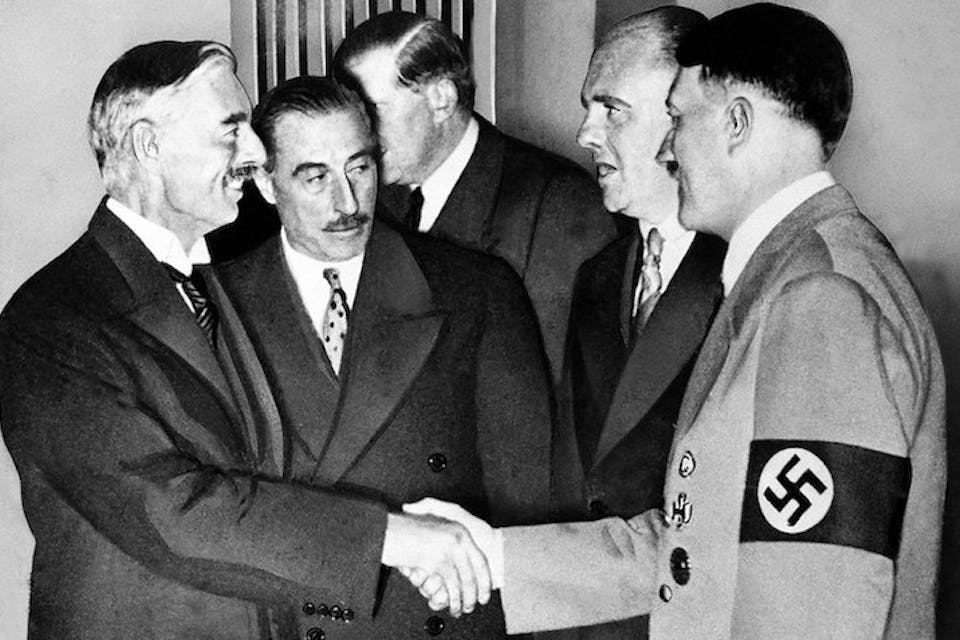
The movie seeks nothing less than to celebrate Neville Chamberlain, a man whose name is eternally affiliated with appeasement. It focuses on the meeting between the British prime minister and Hitler when the latter asserted Germany’s right to the Czech territory Germans called the Sudentenland. Chamberlain conceded and returned home brandishing a signed promise by Hitler not to wage war on Britain.
Told primarily through the eyes of two young aides to these leaders, Munich: The Edge of War pushes back on the notion that Chamberlain was duped by the Führer. The film instead portrays a canny prime minister who seeks to buy time before a war that seems likely to come. In the movie, following the conference at Munich, the English aide glumly goes home and tells his wife that Chamberlain’s deal with Hitler was “just a delay.” He goes on: “The PM’s given us a chance of winning the damn thing when it happens. It’s quite some service when you think about it.” The film further concludes by informing the audience that Chamberlain’s agreement allowed time for Britain to arm, as if preparation for war had been the prime minister’s intention all along.