
September 1, 2021
The Real Truth About the Temple Mount
Someone tell Yair Lapid that the Western Wall is Judaism’s holiest site.
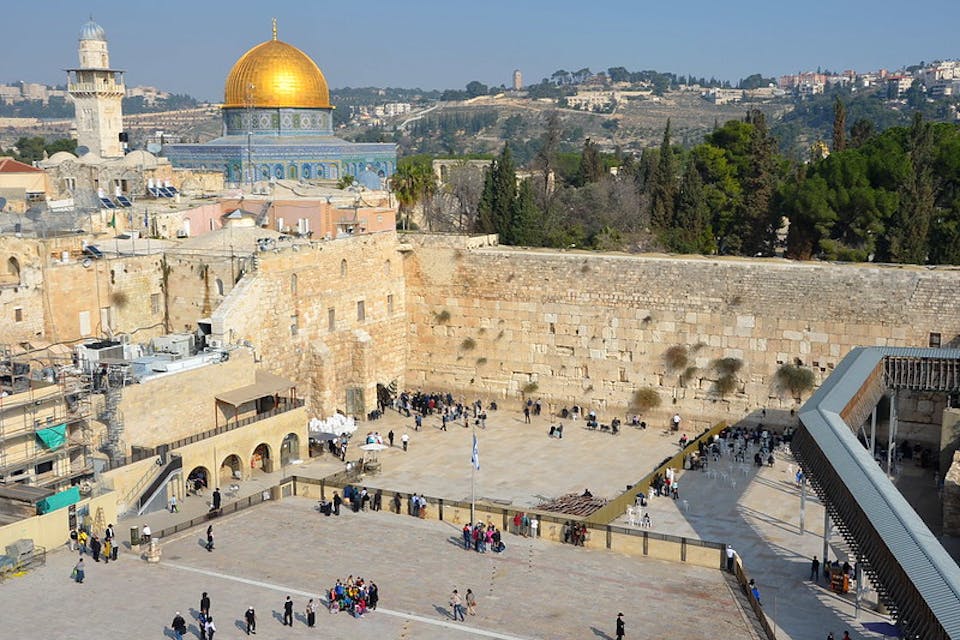
What is Judaism’s holiest site? It is a simple question with an obvious answer. Thrice daily, Jews pray for the restoration of sacred service to Jerusalem’s Temple Mount. It is toward this location that all Jewish prayers have been poured out since the Temple was destroyed. The Mount is the only area on earth where, according to a Jewish law, certain parts cannot be entered in a state of ritual impurity, and many traditional Jews have refrained from ascending to the site lest they violate Jewish law.
Yet many now believe that, with a knowledge of the layout, history, and religious laws pertaining to the location, it is permissible to visit certain parts of the Temple Mount Plaza. They do so under religious guidance, immersing first in a ritual bath, or mikvah, in order to commune with the God they believe still dwells at what is unquestionably Judaism’s holiest site.
In doing so, however, they have still been forced to abide by the “status quo” established by Moshe Dayan in the aftermath of the 1967 Six-Day War. Religious authority over the area is largely exercised by the Muslim waqf, and visiting Jews are literally forbidden to pray. Despite this indignity, religious Jews have continued to come, recently by the many thousands. One of the most popular days of the year to visit is the Ninth of Av, when the Temple was destroyed. The Temple’s destruction is the reason that this day is the saddest of the Jewish calendar, because—obviously—the Temple Mount is Judaism’s holiest site.