

April 20, 2016
How Many Plagues Were There Really in Egypt?
The answer depends on how one punctuates the Bible's Passover story.
Not everyone is fond of the passage in the Passover Haggadah in which three early rabbis—Yosi the Galilean, Eliezer, and Akiva—compete by means of rudimentary algebra to see who can inflict more plagues on the Egyptians at the Red Sea. Yosi, observing that the book of Exodus tells us that the ten plagues in Egypt proper were the “finger of God” but that His “great hand” was at work at the sea, turns this into the five-fingered equation 1/10=5/x, in which x, the number of punishments meted out at the Red Sea, equals 50. Eliezer, claiming that there were not ten but 40 plagues in Egypt proper, gives us 200 as the correct value for x, and Akiva then outdoes him by proposing 50 plagues in Egypt and a value for x of 250.
For whoever feels that ten plagues were quite enough, this is unedifying.
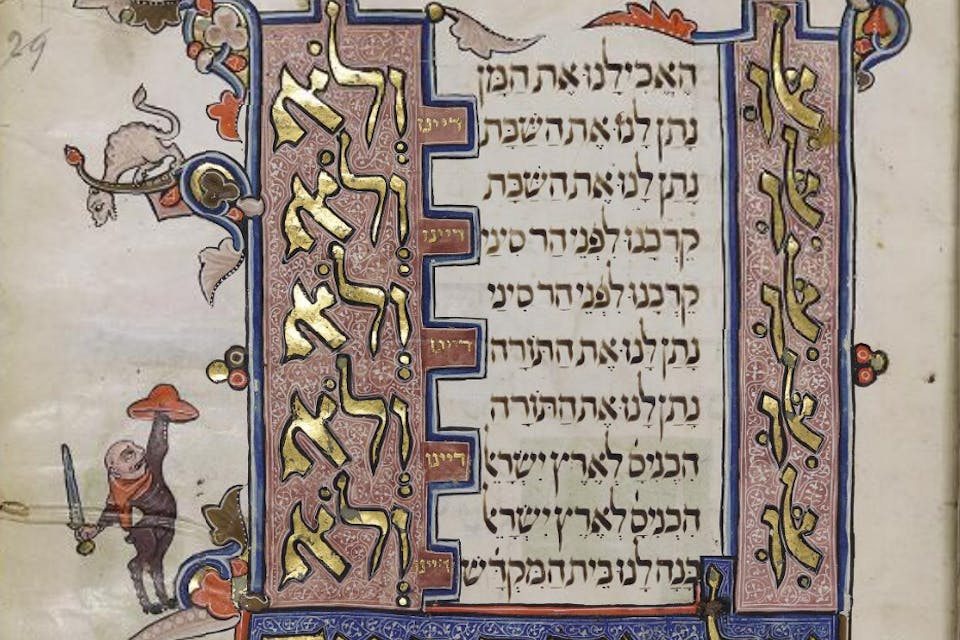
Eliezer and Akiva rely for their equations on the 49th verse of the 78th Psalm, which is a poetic retelling of the Exodus story. The books of the Bible were not written with punctuation (which, as many a bar-mitzvah knows, is part of what makes reading aloud from a Torah scroll so difficult), and a reasonable English version of 78:49’s original unpunctuated version would be, “He [God] let loose upon them [the Egyptians] His fierce anger [ḥaron apo] wrath [evrah] and indignation [va-za’am] and trouble [v’tsarah] a company of evil angels [mishlaḥat malakhei ra’im].”