

July 13, 2023
How the King James Bible Misled Generations of Readers
A misunderstanding about mirrors, with far-reaching, metaphysical consequences.
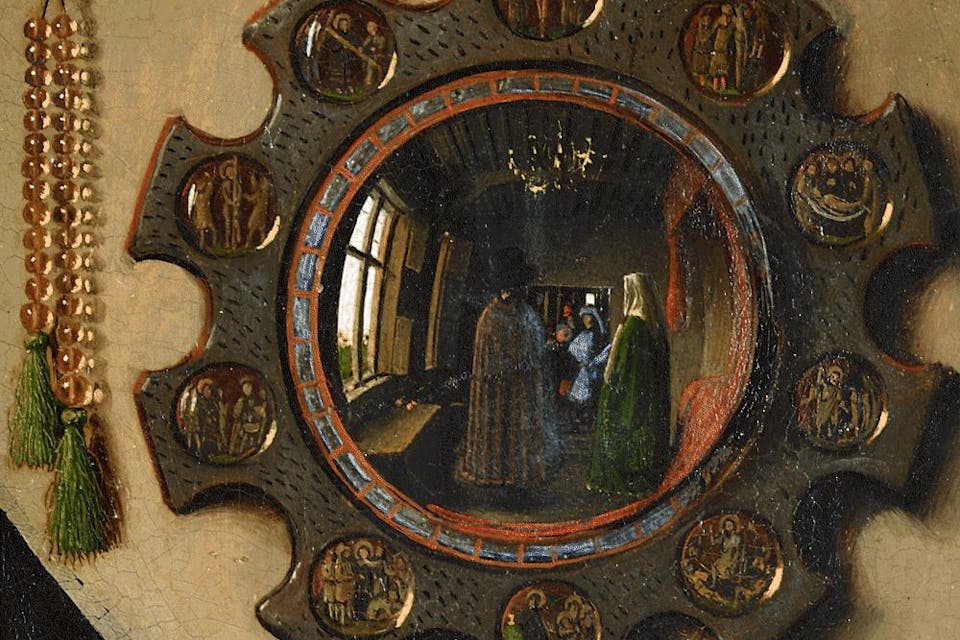
How, it was asked at the end of last week’s column, can one see “through a glass darkly” if that glass is a mirror and mirrors can’t be seen through? Not even Lewis Carrroll’s Alice, who continued her adventures in Wonderland in Carroll’s sequel Through the Looking-Glass and What Alice Found There, was able to see through the mirror of the book’s title. She had to step magically through it without breaking it in order to discover what lay on its other side.
This is why, when we think of the King James Bible’s phrase “through a glass darkly” in Paul’s Epistle to the Corinthians, we do not think of mirrors. Rather, we assume that Paul’s allusion is to looking through a medium like a dark or clouded window pane. The problem with this, however, is not only that Paul, writing in the mid-1st century CE, used the Greek noun eisoptron, which means mirror and not window, but that glass windows did not exist in the Graeco-Roman world until that century’s end, after which they remained a rarity for a very long time. Paul could not possibly have had them in mind. He could not even have been thinking of glass mirrors, which first appeared even later, close to 300 CE. An eisoptron, as we have observed, was a mirror of burnished metal, generally bronze, copper, or—the most expensive and best element for the purpose—silver. It most often took the form of a hand mirror used for personal grooming and needed frequent polishing to avoid tarnish and a loss of reflectivity.
The Latin word for such a mirror was speculum, from which came the Hebrew aspaklariyah mentioned in the tractate of Y’vamot’s “The prophets saw in a mirror that was not bright while Moses saw in a mirror that was bright.” Another version of this can be found in the early medieval midrashic compilation of Vayikra Rabbah, which states, “All the prophets saw in a mirror that was tarnished while Moses saw in one that was polished.” Both assertions tell us that Moses and the prophets glimpsed the Divine in a mirror (b’aspaklariya), not “through” one. In this they are in agreement with two English translations of Paul’s phrase that preceded the King James Version’s, the 1382 Wycliffe Bible’s, and William Tyndale’s 1536 New Testament’s. The former has “and we see now by a mirror in darkness,” and the latter, “now we see in a glass even in a dark speaking.” (“In a dark speaking” is Tyndale’s rendering of Paul’s en ainigmati, the Greek word ainigma, the source of our English “enigma,” denoting a difficult riddle.)