

September 3, 2020
The New Book On Religious Freedom That Defines Religion Down
A distinguished historian of the American founding sees religion as a matter of individual belief rather than communal obligation.
This past term, in Our Lady of Guadalupe School v. Morrissey-Berru, the Supreme Court took up the question of whether the so-called “ministerial exception” applies to teachers of religion at parochial schools. That constitutional doctrine allows for religious organizations to select, supervise, and remove religious leaders—“ministers”—without interference from civil authorities. The teachers at issue in this particular case were not officially reverends, priests, nuns, or rabbis, so the court had to decide whether the exception applied to them even though they lacked formal ordination. In the end, the court ruled that the exception applies. The court reasoned that what ultimately matters under the Free Exercise Clause of the First Amendment of the Constitution is not the religious-school employee’s title or credential, but what the employee does. A person is a “minister” if they lead the organization, conduct worship services or other important rituals, or serve as a “messenger or teacher of the faith.”
In other words, the Constitution protects the women and men who strengthen the faith of Americans. What’s notable about Justice Alito’s opinion for a seven-justice majority in Our Lady of Guadalupe School v. Morrissey-Berru is that it did not rely solely on constitutional explication or on founding-era history, as one might expect from the court. Instead, to understand the reach of the constitutional protection, Alito wrote about religious pluralism today, taking stock of the “rich diversity” of contemporary American life. While Catholics, Protestants, Jews, Muslims, Mormons, and Seventh-Day Adventists—to name the religions Alito specifically examined—differ in the titles of their ministers and in their organizational structures, they all share a foundational commitment to religious instruction. The implication of Alito’s brief survey was that a strict and legally formalist rendering of the ministerial exception—pertaining only to those officially ordained—would not do justice to the reality of American religious pluralism.
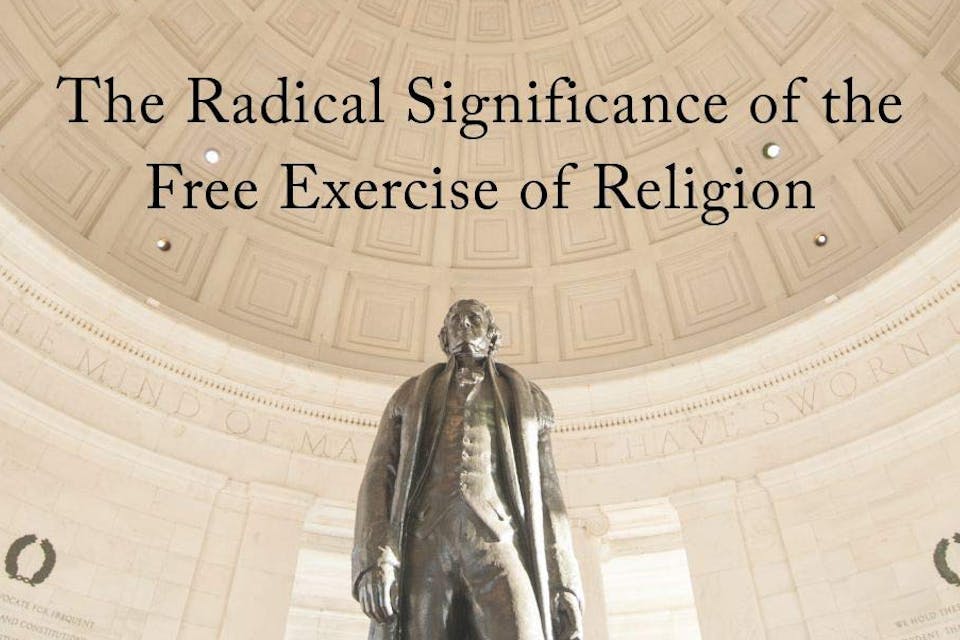
Alito’s jurisprudence is thus a response to the amazing religious diversity of contemporary America. It turns out that the vital tension between the theory and practice of American religion has in fact forged a great deal of First Amendment doctrine. That is the argument that the Stanford historian Jack Rakove advances in Beyond Belief, Beyond Conscience: The Radical Significance of the Free Exercise of Religion. In the book, he attempts to wrest the Free Exercise Clause away from the lawyers and their vocational focus on language and logic, and offers instead an intellectual history of American religious liberty that explains how its evolutions and quandaries are the product of historical circumstance. His project has enormous consequences for American Catholics and Muslims, although perhaps no group is more affected by the questions raised in this study than American Jews.