
August 1, 2016
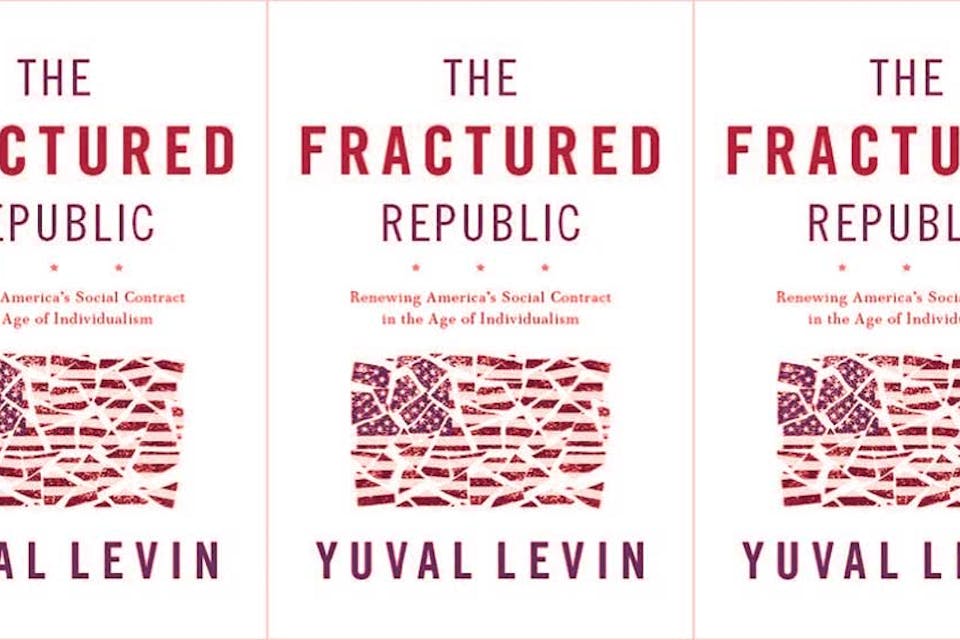
Meir Solveichik on Yuval Levin’s ‘The Fractured Republic’
What the “revolution in the structure of American religiosity” means for the United States.
A response to Yuval Levin, the editor of National Affairs, and his important book The Fractured Republic.
The most sobering feature of Yuval Levin’s brilliant analysis of America’s “fractured republic” is what he calls a “revolution in the structure of American religiosity.” Multitudes of Americans, Levin persuasively argues, have ceased to view traditional religion as “an ideal with which to nominally identify” and have come instead “to see it as an option to reject.” It is not, he points out, that the dedicated members of traditional faiths are dwindling; on the contrary, religious communities are vibrant, and flourishing. At the same time, they have become counter-cultural; the biblically based consensus that at one time “contributed enormously to the cohesion and success of American society” has evaporated, adherents of religious orthodoxy have “lost their place of honor in the moral life of our society,” and an increasing number of Americans have even become “hostile to religion to varying degrees.”
In such an environment, Levin wisely counsels believers in America not only to fight for religious liberty, but also to allow their flourishing communities to teach by example. They should offer, he suggests, an alternative moral order that is not only negative but also positive, drawing people’s eyes and hearts “to the vast and beautiful ‘yes’ for the sake of which an occasional narrow but insistent ‘no’ is required.” Traditional faiths in America, Levin suggests, should serve as “living models of practical orthodoxy,” ever-mindful of Tocqueville’s insights that in eras dominated by individualism, it is the firmly orthodox institutions that prove most attractive “thanks in no small part to their countercultural character.” Traditionalists should illustrate by their very lives that a genuinely biblical, and authentically American, version of freedom is “not only that people be free to choose, but also that they be able to choose well,” living their faith in the world confident that their example “will make that world better and be drawn to the spark.” In other words, they must learn to balance being both part of, and apart from, society, confident in the face of a much more secular society, and even in the face of Americans who may at times be hostile to their faith.