
About the Author
Gary Saul Morson is the Lawrence B. Dumas professor of the arts and humanities at Northwestern University and the author of, among other books, Anna Karenina in Our Time (Yale).
July 27, 2026
Utopians yearn for a Newtonian creator, but our world is dappled, full of surprise, failure, and freedom.
When it turned out that there were not just three elementary particles—electrons, protons, and neutrons—but an array of smaller ones seeming to fit no system, Enrico Fermi allegedly remarked, “If I had wanted to remember the names of seventeen particles, I would have become a botanist.”
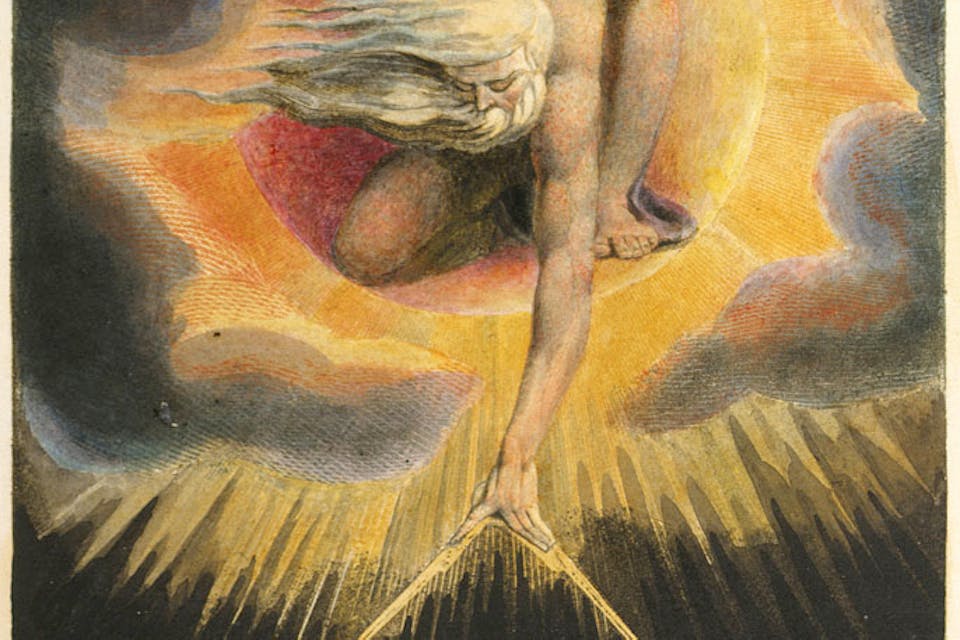
This comment, which has also been attributed to Albert Einstein, expresses a particular view of the universe that has been especially important in the history of physics: behind the apparent complexity of things, a few simple laws govern. Botanists multiply, physicists reduce. The Ptolemaic astronomical system posited a bewildering mélange of complex cycles and epicycles to account for the puzzling movement of the planets, which sometimes even switched direction and moved backward, but Newton replaced all that Ptolemaic machinery with four simple laws. It was the greatest scientific achievement in history. As Alexander Pope famously declared, “Nature and Nature’s laws lay hid in night:/ God said, Let Newton be!, and all was light.”
Newton’s laws became a model of truly scientific explanation. Since then, countless thinkers—whom Élie Halévy memorably called “moral Newtonians”—have tried to do for the social world what Newton did for the solar system. Surely all the complexity we see around us must follow some discoverable fundamental principles. Jeremy Bentham, Karl Marx, Sigmund Freud, B.F. Skinner—and more recently the behavioral economist Gary Becker and the popular historian Jared Diamond—along with many others have claimed to have discovered those simple principles. The fact that ever more such claimants, like the inventors of faddish diets, keep appearing is a sure sign that they have not succeeded.
When it turned out that there were not just three elementary particles—electrons, protons, and neutrons—but an array of smaller ones seeming to fit no system, Enrico Fermi allegedly remarked, “If I had wanted to remember the names of seventeen particles, I would have become a botanist.”
This comment, which has also been attributed to Albert Einstein, expresses a particular view of the universe that has been especially important in the history of physics: behind the apparent complexity of things, a few simple laws govern. Botanists multiply, physicists reduce. The Ptolemaic astronomical system posited a bewildering mélange of complex cycles and epicycles to account for the puzzling movement of the planets, which sometimes even switched direction and moved backward, but Newton replaced all that Ptolemaic machinery with four simple laws. It was the greatest scientific achievement in history. As Alexander Pope famously declared, “Nature and Nature’s laws lay hid in night:/ God said, Let Newton be!, and all was light.”
Newton’s laws became a model of truly scientific explanation. Since then, countless thinkers—whom Élie Halévy memorably called “moral Newtonians”—have tried to do for the social world what Newton did for the solar system. Surely all the complexity we see around us must follow some discoverable fundamental principles. Jeremy Bentham, Karl Marx, Sigmund Freud, B.F. Skinner—and more recently the behavioral economist Gary Becker and the popular historian Jared Diamond—along with many others have claimed to have discovered those simple principles. The fact that ever more such claimants, like the inventors of faddish diets, keep appearing is a sure sign that they have not succeeded.
Moral Newtonians are guided by the faith that there aren’t seventeen random social particles, just one law from which they can all be derived. Their God, the divine mathematician, delights in simplicity, symmetry, homogeneity, smoothness, and perfect fit. Contingency, surprise, and lopsidedness are all merely apparent. If we see a world irreducible to perfect order, it is our perception that is at fault. Pope again: “All seems infected that the infected spy,/ As all looks yellow to the jaundiced eye."
When I gave up my plan to become a physicist in order to focus on Russian literature, it was partly because I no longer found this view of the world appealing. No, God more closely resembled a botanist than a physicist, and, if one did not blind oneself with prior assumptions that no evidence could shake, the social world clearly displayed endless contingency, asymmetry, and surprise. And it was then I came across what became my favorite English poem, Gerard Manley Hopkins’s “Pied Beauty”:
Glory be to God for dappled things—
For skies of couple-colour as a brinded cow;
For rose-moles all in stipple upon trout that swim;
Fresh-firecoal chestnut-falls; finches’ wings;
Landscape plotted and pieced—fold, fallow, and plough;
And áll trádes, their gear and tackle and trim.
All things counter, original, spare, strange;
Whatever is fickle, freckled (who knows how?)
With swift, slow; sweet, sour; adazzle, dim;
He fathers-forth whose beauty is past change:
Praise him.
Cows are “brinded” when streaks and stripes stain their brownish coats; the pinkish spots on trout are called “rose-moles”; engravers “stipple” a surface with many specks and dots. “Fresh-firecoal chestnut-falls” refers to the way that chestnuts, when split open, may resemble glowing embers. When we survey a landscape that has been prepared for agriculture—fold, fallow, and plough—its plots and pieces are anything but geometric or symmetrical. The land we cultivate is not a Euclidian plane. That is also why streets in London are not straight and change their names frequently. Only cities designed by utopian architects have a geometrically perfect downtown at war with nature, as we see when (as in Philadelphia) the moment the city grows beyond the initial plan it does so haphazardly, adjusting to each local terrain or human need.
“All trades with their gear and tackle and trim”: I used to go to giant hardware stores just to contemplate the odd shapes of many tools and wonder what need, what natural excrescence or human contrivance, had necessitated such a shape. Peculiarity was everywhere. To learn a trade is to acquire a familiarity with tools one could not have imagined and to learn a vocabulary applicable nowhere else. And as new inventions create new trades, the stock of odd things and freshly minted words grows. They never turn out to be manifestations of a single simple principle.
Where are the heavens of yesteryear? To contrive what they imagine to be the perfect society, utopians assume that people are knowable, that they desire the same thing, and that the values and wants of today will persist forever. But they don’t. Only imagine yourself a citizen of the great utopian schemes of the 19th century in order to realize that what once seemed like paradise now looks like prison. Women, for instance, were to be given a secure place and set of prescribed occupations, suitable for their supposedly inferior abilities, where they would be happy not having to compete with men. Yesterday’s sanity is today’s sickness. Nevertheless, utopian schemes to be imposed by wise central planners keep attracting followers. “All this the world well knows, yet none knows well/ To shun the heaven that leads men to this hell.” (Shakespeare, Sonnet 129).
Utopian schemes appeal to those who find the greatest comfort in fitting in. They cannot imagine why someone would want to be the odd one out, and may find such a subversive wish dangerous. In the conformist USSR it was dangerous, as well as rude, to call attention to oneself. The plot of many dystopian novels, like Aldous Huxley’s Brave New World, recounts how a hero (or heroine) decides to reject the perfect, drugged happiness that is always the same. He decides to depart from familiar safety and create something one has not been given because, he reasons, only then can one’s life truly be one’s own. One wants to be an “idiot” in Dostoevsky’s sense: completely idiosyncratic. As Russian novels repeat, meaning is not the same as happiness. One must embrace risk, which of course includes failures.
The anti-utopian individual loves “all things counter, original, spare, strange.” Counter: what goes against received thinking. Original, in the sense of something one does not receive readymade but “originates.” Spare: something extra, held in reserve, a fifth wheel—and also something inappropriate that others would dispose of but is better “spared.” And strange: unfamiliar, foreign, difficult to explain, what does not fit.
Whatever is fickle—can’t be counted on to behave the same way—and freckled: with dots marring a smooth skin and following no pattern. It is a matter of opposites coexisting: swift, slow; sweet, sour; adazzle, dim. Adazzle is itself a strange word, naming something that temporarily blinds and confuses us.
Moral Newtonians and political utopians want nothing more than to banish all this mess. They want a world fitting what Leibniz called the principle of “sufficient reason”: there must be a reason explaining that whatever exists must be the way it is and could be no other way. By contrast, Aristotle, a great biologist to whom the wandering Alexander the Great sent strange specimens, believed in irreducible contingency. As he defined the term, a contingent event is one that “can either be or not be.” The world could be one way, or another, or yet another. Chance, which can be disruptive, and choice, which is often suboptimal, make a difference. In mathematical reasoning, there are no exceptions, no triangles of 179 degrees, but in the social world, Aristotle insisted, things are the way they are “on the whole and for the most part,” one of his favorite phrases.
God Himself does not change. He is all of a piece. But for some reason He chose to make a pied and shifting world, where there is a special beauty in the strangenesses that tease us out of thought.
The great 18th-century deists—like Thomas Paine or Voltaire—imagined a God who created the world and then let it be. When Einstein said he believed in “the God of Spinoza,” this, I think, is what he meant. That God, Einstein famously said, created a world without chance since He “does not play dice with the universe.” This is the God I believed in when I aspired to be a physicist. I wanted to reveal the simple, perfect, mathematically pure laws explaining the stupefying complexity around me. Only then could I have a sense of control.
If God, having made the world, lets it be, then prayers make no sense. By the same token, there can be no miracles. For Leibniz, to believe in miracles—God or people with special powers violating the laws God made—was to treat those laws as less than perfect, since they had to be suspended. Unable to prove the stability of the solar system, Newton had proposed that occasionally God intervened to give heavenly bodies a little push. Leibniz was horrified: are you saying, he asked, that God is “an inferior watchmaker”?
Of course, it would not have been safe for Leibniz to deny Moses splitting the Red Sea or Jesus raising Lazarus from the dead, so instead of denying miracles, he did what philosophers often do when they find themselves boxed in: he redefined the word. When terms can be redefined, no problem is intractable. A miracle, Leibniz argued, is not an event that contravenes the perfect laws of nature but one that happens extremely rarely—like snow in the Sahara—and only seems to contravene them.
But as the brilliant mathematician, physicist, and philosopher Blaise Pascal—who invented probability theory—pointed out, chance and contingency really do exist. They are not illusions to be banished when the right laws are discovered, but are part of the nature of things. Pascal coined the most famous phrase to describe how some chance event or feature, which no theory could anticipate, could make all the difference: “Cleopatra’s nose: had it been shorter, the whole face of the world would have changed.”
In the intense religious encounter he called his “night of fire,” Pascal found that the God of abstract laws and timeless principles afforded him no hope or comfort. It was not God the mathematician that he needed, but the God of the Bible stories. Or as he wrote on the night that changed the rest of his life: Pascal craved “not the God of the philosophers, but the God of Abraham, Isaac, and Jacob.”
The world of the Hebrew Bible is not the world of Leibniz. If it were, there would be no need to explain things by narrative. The Torah would outline quasi-Newtonian laws rather than tell stories. God would not test Abraham, nor would He be repeatedly surprised by Israel’s backsliding. For me, the God I found in the Bible was Aristotelian, not Leibnizian, a God of botany and irreducible social complexity. And He made each of us uniquely, unrepeatably, and irreducibly individual and free. Our actions can be one way or another, and so they make a difference.
In the ethical realm, there is no equivalent to Newton’s four laws from which everything can be derived. Leviticus prescribes rules that have inspired and required centuries of Jewish exegesis. The wisdom book of Proverbs contains 31 chapters and 915 verses. Perhaps there are 613 mitzvot because God does not confine himself to round numbers.
Praise Him.
Part of:

Gary Saul Morson is the Lawrence B. Dumas professor of the arts and humanities at Northwestern University and the author of, among other books, Anna Karenina in Our Time (Yale).
Unlock the most serious Jewish, Zionist, and American thinking.
Subscribe Now