
About the Author
Gary Saul Morson is the Lawrence B. Dumas professor of the arts and humanities at Northwestern University and the author of, among other books, Anna Karenina in Our Time (Yale).

October 19, 2026
Confronted with the problem of evil, the Bible and Dostoevsky offer what philosophy cannot.
“Oh, Lord, how long shall I cry, and Thou wilt not hear!” demands the prophet Habakkuk. “Therefore the law is slacked and justice never goes forth. For the wicked surround the righteous, so justice goes forth perverted” (Habakkuk 1:2-4). The prophets, the Psalms, and especially the book of Job demand an answer: why does a beneficent God allow evil to triumph and the righteous to suffer? Why is justice “perverted”?
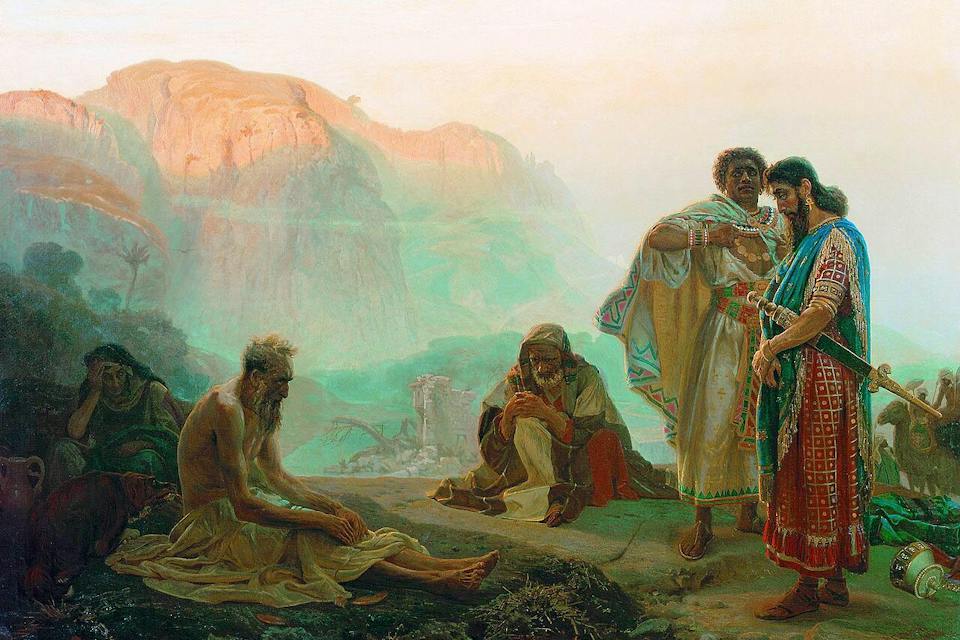
When Job proclaims his innocence, his friends insist that he must have sinned to merit punishment. As they assert what Robert Alter has called “the traditional moral calculus”—evil is punished and good rewarded—Job calls their sanctimonious speeches mere “words” (Job 19:2). After all, natural disasters do not spare the innocent: “He destroyeth the perfect and the wicked. If the scourge slay suddenly, He will laugh at the trial of the innocent” (9:22-23). Crimes escape punishment. If only it were possible to confront God and make him answer, Job implores: “Oh, that I knew where I might find him! . . . I would order my cause before him, and fill my mouth with arguments” (23:3–4).
The book of Job stands as the classic statement in Western culture of the “problem of evil” and the question of theodicy, or the justification of God. Milton’s Paradise Lost aspires to “justify the ways of God to men.” Although there have been many restatements of Job’s questions, it was not until the chapter “Rebellion” in Dostoevsky’s Brothers Karamazov that they were posed even more powerfully than in the Bible. Ivan Karamazov, the brother most tormented by theological questions, means to out-Job Job.
Ivan strives to shake the faith of his pious brother, Alyosha, who has been living at a monastery to learn from the wise Father Zossima. Raised apart, the brothers meet in a stinking tavern to become better acquainted. Ivan explains that he is not an atheist, as Alyosha has assumed, but an anti-theist. He does not deny God but condemns Him.
Job only wishes he could confront God, but Ivan directly challenges Alyosha, who represents Zossima, the bearer of pious wisdom. Setting the ground rules for their debate, Ivan precludes one reply in advance. Alyosha must not give the answer God gave to Job: you can’t understand, you must just believe. If one argues that way, why bother to talk at all? Alyosha must answer Ivan, not dismiss his challenge.
Ivan explains that what he cannot accept is God’s universe, not God Himself: “and although I know it exists, I don’t accept it at all.” He means that the world is morally unacceptable. Citing the usual promise that “at the world’s finale, at the moment of eternal harmony, something so precious will come to pass that it will suffice for all hearts, . . . for the atonement of all the crimes of humanity, . . . that it will make it not only possible to forgive but to justify all that has happened with men,” Ivan insists that even if that happens, “I don’t accept it, I won’t accept it.” Why?
“I meant to speak of the suffering of mankind generally,” Ivan begins his indictment, “but we had better limit ourselves to the sufferings of children. That reduces the scope of my argument to a tenth of what it would be. Still, we’d better keep to the children, though it does weaken my case.” Far from weakening his case, of course, this “limitation” strengthens it. Adults are all sinners, after all, so it is always possible that they have somehow deserved their punishment, but young children are entirely innocent. “Children, when they are quite little . . . are so remote from grown-up people; they are, . . . as it were, a different species.” Their suffering at the hands of abusers is therefore totally unwarranted. And yet that suffering is all too common.
Ivan has assembled a little “collection of facts,” horrendous stories of child abuse, all of which had actually appeared in the Russian press. As Dostoevsky’s readers would have known, they weren’t invented. “People talk of bestial cruelty,” Ivan remarks, “but that’s a great injustice . . . to the beasts; a beast can never be so cruel as a man, so artistically cruel.” A tiger would never think of slowly torturing children or throwing them in the air and catching them on the points of their bayonets “before their mother’s eyes. Doing it before the mother’s eyes was what gave zest to the amusement.” But that is what the Turks had only recently done when suppressing revolts of their Slavic subjects. Imagine a Turk playing with a little baby and making it laugh, Ivan continues. The Turk then “points a pistol four inches from the mother’s face. The baby laughs, holds out his little hands to the pistol, and he pulls the trigger in the baby’s face and blows out its brains. Artistic, wasn’t it?”
Ivan is a misanthropic multiculturalist: much as every nationality has its own folk customs and distinctive cuisine, each has its preferred method of torture. Russians favor “rods and scourges—it’s our national institution.” Cultivated Swiss Protestants prefer to add psychological torture.
After describing each case of abuse, one more horrible than the last, Ivan paraphrases a standard justification of God. A little girl is thrashed by her parents till her body is one bruise, then shut up in an outhouse and made to eat her own excrement. There she weeps “her meek, unresentful tears to dear, kind God to protect her.” The philosophers explain that if not for evil, man could not have known good, but Ivan deems that argument absurd. “Why, the whole world of knowledge is not worth that child’s prayer to ‘dear, kind God.’” Ivan does not refute the philosophers and theologians. Rather, he presents each of their arguments alongside his vivid rendition of each case of child abuse, as if to say: what sort of a person could find the justification more powerful than the crime? Pictures, not words, counter theodicies. Argument fails. The strength of this method is that it refutes not only every justification of God that has ever been made, but also all that ever could be made.
Even if God at the last judgment should provide a good answer, it would not matter to Ivan. “I would rather be left with the unavenged suffering,” he explains, “even if I were wrong.” Indignation trumps theory. If the suffering of a single innocent child is necessary for eternal harmony, Ivan continues, then “I don’t want harmony.” Ivan imagines that at the world’s finale God first forgives him for his blasphemy because it was born of compassion, and then gives him his “ticket” to heaven. Ivan rejects that ticket in advance, “and if I am an honest man I am bound to give it back as soon as possible. It’s not God that I don’t accept, Alyosha, only I most respectfully return Him the ticket.” Alyosha replies: “That’s rebellion”—metaphysical rebellion, hopeless rebellion against the universe itself.
Reading the draft of this chapter, the head of the Russian church wondered how Dostoevsky could possibly answer it! But he does, only not directly. Dostoevsky follows his hero’s method: as Ivan asks us to compare each picture of child abuse with its putative justification, Dostoevsky invites us to compare Ivan’s vision of the world with Zossima’s. One is based on moral outrage, the other on wisdom, love, and, most of all, wonder.
When I read these passages, I think of Abraham Joshua Heschel’s stress on wonder, not doctrine, as essential to faith. “Wonder . . . is the chief characteristic of the religious man’s attitude. . . . To the prophets wonder is a form of thinking,” Heschel explains in God in Search of Man. Ivan demands an argument, but the proper response is an attitude, a sense of the world as a whole. “Wonder or radical amazement, the state of maladjustment to words and notions, is therefore a prerequisite for an authentic awareness of that which is. . . . While any act of perception or cognition has as its object a selected segment of reality, radical amazement refers to all of reality. . . . The profound and perpetual awareness of the wonder of being has become a part of the consciousness of each Jew.”
The answer to Ivan’s indictment is not a proposition but the sense of life presented by the novel as a whole. Literature does what philosophy can’t, which is one reason literature exists. In much the same way, Job is answered by the entire Hebrew Bible, with its sense of the divine, the ineffable, and the wondrous.
Part of:

Gary Saul Morson is the Lawrence B. Dumas professor of the arts and humanities at Northwestern University and the author of, among other books, Anna Karenina in Our Time (Yale).
Unlock the most serious Jewish, Zionist, and American thinking.
Subscribe Now