

October 19, 2023
Can the Hebrew Word for Catastrophic Blunder Be Translated?
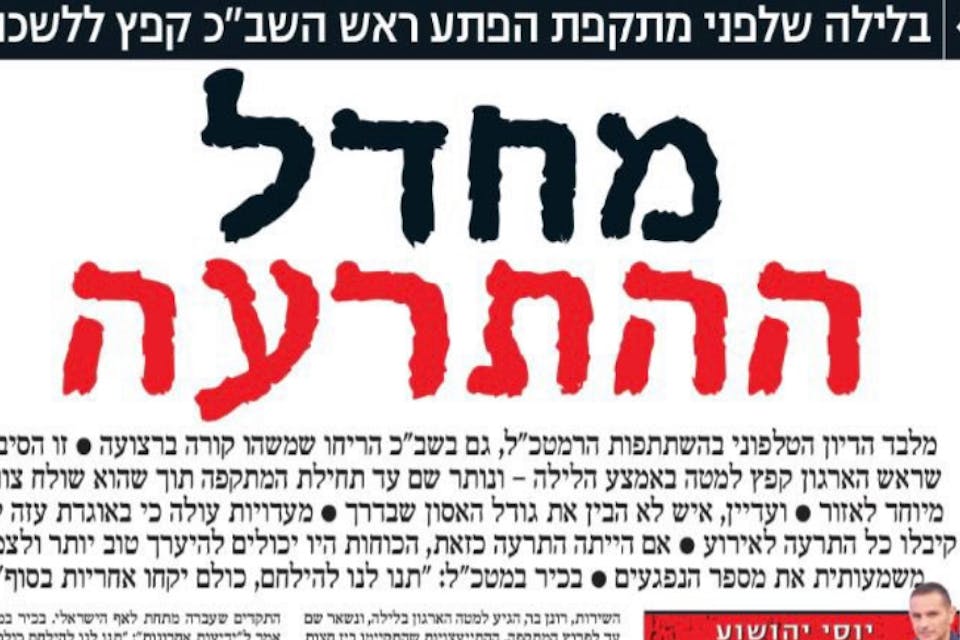
A meḥdal occurred in 1973. It has now, in an eerily similar way, occurred again. What exactly does it mean in English?
Always be careful what you ask for!
A few weeks before last Yom Kippur, Jonathan Silver, Mosaic’s editor, turned to me with a query. He was preparing for publication Michael Doran’s essay “The Hidden Calculation Behind the Yom Kippur War,” which appeared in Mosaic earlier this month, and he wanted to know how I would translate the Hebrew word meḥdal. In his essay, Doran had written:
Israelis have at their fingertips all the necessary facts [about the 1973 war] to tell a compelling story of triumph over tragedy, much like the one Americans tell themselves about World War II. A sneak attack by the enemy caught the lion sleeping. He made some early missteps, but once stirred from his slumber, he ripped his enemies to shreds. The [Golda] Meir government tried to market such a tale when the war ended, but the public rejected it out of hand. Israel’s collective memory immediately conceived of the war as neither a victory nor a defeat. . . . The word it chose was meḥdal, which technically means an act of omission or neglect that leads to great harm. Israelis remember the Yom Kippur War not just as a meḥdal, but as “the meḥdal”—the meḥdal par excellence.