

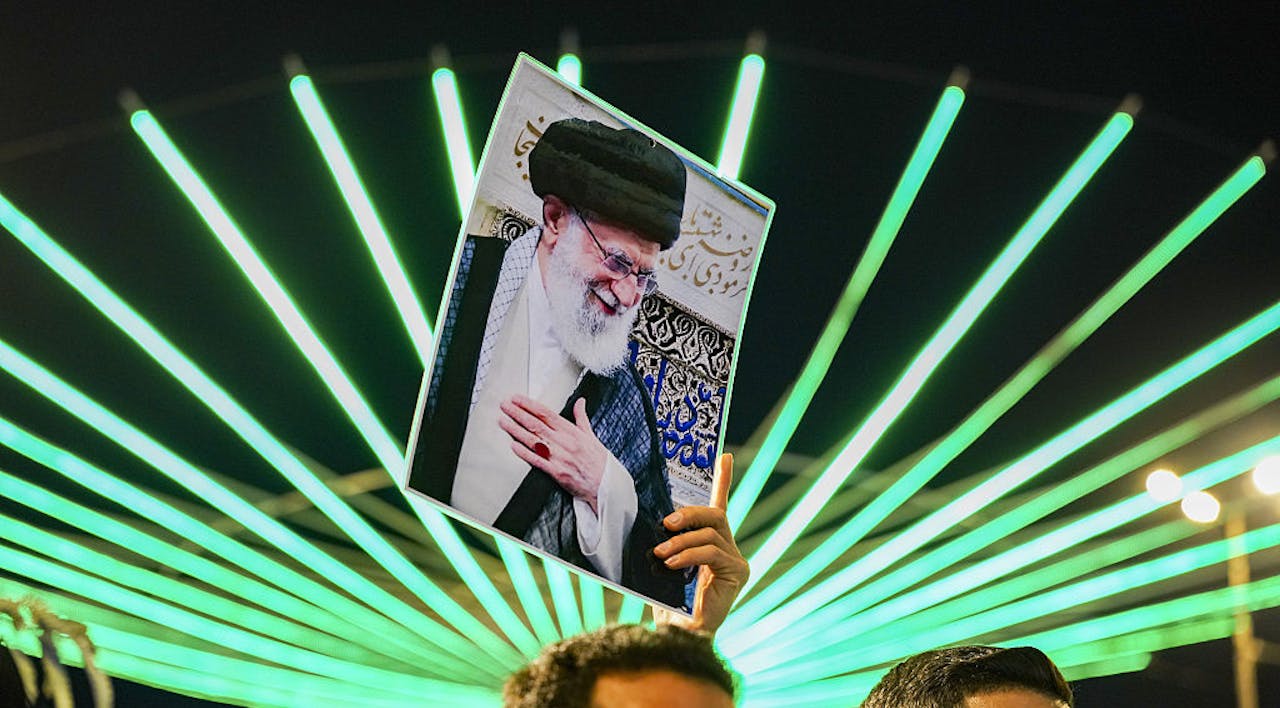
March 2026
After the Ayatollah
The death of Ali Khamenei and the end of political Islam’s century-long experiment in power.
Ayatollah Ali Khamenei is dead. The man who ruled the Islamic Republic of Iran for 36 years, outlasted six American presidents, built and sustained the most consequential sponsor of terrorism in the modern Middle East, forged an empire that extended from Iran to the Mediterranean shores in the north and to the entry of the Red Sea in the south, whose proxies dragged Lebanon, Syria, Iraq, and Yemen into decades of war and chaos, whose Revolutionary Guard propped up Bashar al-Assad as he gassed and barrel-bombed his own population into the largest refugee crisis since the Second World War, whose Houthis brought famine to Yemen, whose funding and direction made October 7 possible, and whose missiles rained on Israel as Hamas executed the worst massacre of Jews since the Holocaust, who oversaw the weekly chants of “Death to America” and “Death to Israel” as liturgical rituals of his power—that man is gone, killed on a Saturday morning by the joint force of the two nations he swore to destroy.
He was eighty-six years old. He had been the supreme leader since June 4, 1989, elected by a special committee called the Assembly of Experts within hours of the death of Ayatollah Ruhollah Khomeini, the founder of the Islamic Republic, to a position for which he was, by the theological standards of Shiite jurisprudence, never fully qualified. Khamenei was a hojatoleslam, a mid-ranking title of respect for Shiite clerics, meaning “proof of Islam” or “authority on Islam.” Unlike his predecessor, he was not a grand ayatollah. His authority, therefore, was political rather than scholarly. He compensated for this deficit with ruthlessness, patience, and an unshaking commitment to the revolutionary project that consumed his entire adult life. He was nineteen when he first began studying under Khomeini. He was a revolutionary before he was anything else, imprisoned under the shah, wounded by an assassination attempt in 1981 that cost him the use of his right arm, and installed as president at forty-two in the chaotic aftermath of the Islamic Revolution. He served two terms, was elevated to supreme leader, and proceeded to outlast every rival, every reformist, every protest movement, and every American attempt at negotiation, containment, and coercion—until Saturday.
His career was the Islamic Republic. There is no separating the two. When Khomeini died in 1989, shortly after the end of a long, brutal, and destructive war with Saddam Hussein’s Iraq—a ceasefire Khomeini himself compared to drinking poison—the state he left behind was impoverished, volatile, and fractured. It was Khamenei who stabilized it—not through charisma, which he lacked, nor through theological authority, which he never fully possessed, but through the methodical cultivation of the Islamic Revolutionary Guard Corps (IRGC) as a parallel state, simultaneously economic empire, global terror network, and a praetorian guard whose fortunes were indistinguishable from his own.


