


May 11, 2026
Israel Needs a Small Grand Bargain
A senate is a step forward, but Israel needs more.
Sagi Barmak and Amiad Cohen propose adding an upper house to the Israeli legislature, offering a detailed roadmap that addresses questions of composition, responsibilities, and the mechanics of elections. Theirs is a creative and elegant solution that engages seriously with Israel’s constitutional deficiencies. But a sound reform requires both a correct diagnosis and a proper course of treatment—and on both counts, the proposal falls short. A senate is a very good start. But on its own, it is unlikely to pass political muster, unlikely to fix Israel’s functional deficiencies, and unlikely to quiet the controversies tearing at Israeli society. A successful reform would need to do more: to inject some problem-solving energy into Israeli politics and to address key controversies in a way that offers something to everyone. Israel needs what I call a “small grand bargain.”
Now let’s unpack this argument, beginning with why a senate would be a good—even great—step toward a solution.
Barmak and Cohen are correct to point out that the Knesset, Israel’s unicameral legislature, acts more as an extension of the executive than as a check on its power. With just one ballot, used to vote for a party—not a representative, nor a chief executive—the elections create highly dependent and intertwined political institutions, where the executive controls the legislature through its ruling coalition in the Knesset. Absent independently elected legislators or an upper house, only the Supreme Court can truly restrain the two branches, leading to frequent judicial overreach and fierce controversies about the Court’s role and legitimacy.
Responses to April ’s Essay

April 2026
Israel’s Constitutional Crisis Was Really a Demographic Crisis
By Rafi DeMogge
April 2026
An Israeli Senate Would Defend the Establishment from the People
By Gadi Taub and Avi Bareli
April 2026
To Solve Its Constitutional Crisis, Israel Needs a Constitution
By Yuval Levin
April 2026
Israel Needs a Small Grand Bargain
By Netta Barak-Corren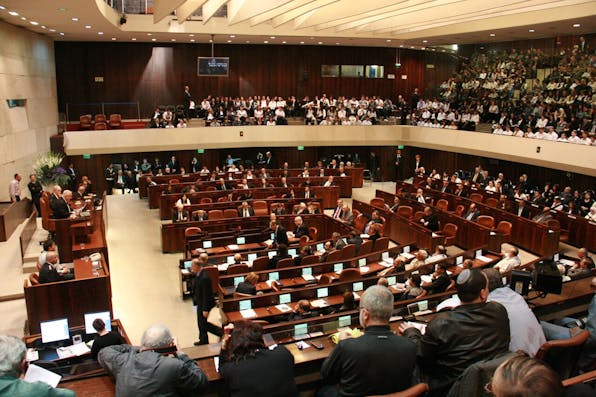
April 2026
The Time is Ripe for the Next Chapter of Israel's Constitutional Life
By Sagi Barmak and Amiad Cohen


