
In their seminal essay, “America’s Hebraic Awakening,” Eric Cohen and Jonathan Silver argue that the rediscovery of the Hebrew Bible and its role in shaping the American founding is necessary for national renewal. Here they draw on the work of such scholars as the political theorist Joshua Mitchell, who has written convincingly of the “Hebraic Christianity” that lay behind our nation’s founding. Wilfred McClay and Stuart Halpern have likewise shown how American liberties were grounded in the Founders’ use of Jewish antecedents. In her response to Cohen and Silver, Luma Simms suggests that it was Protestant recognition of the “social dimensions of sin” and the need for political restraints that turned the Founders to biblical Israel for instruction. In passing, she dismisses Jonathan Edwards’s (1703–58) teachings as too “extreme” for furthering that instruction.
But Edwards in fact had considerable influence on the colonies’ Hebraic spirit, and therefore indirectly on the Founding, an influence far too important to ignore.
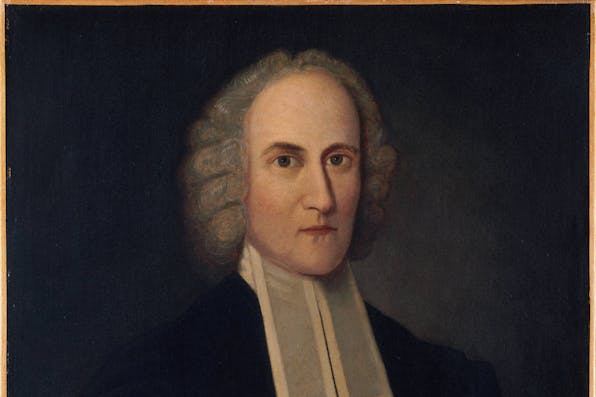
Most Americans know Edwards as the preacher of the sermon “Sinners in the Hands of an Angry God,” called by some the best and by others the worst sermon in American history. Few Jews or Christians know that this famous sermon on the danger of hell is a meditation on Deuteronomy 32:35 and is illustrated with thirteen texts from the Hebrew Bible and only five from the New Testament. Edwards was indeed a hellfire and damnation preacher—a style whose revival might not be a bad thing in a nation full of churches with little or no fear of God—but far more. Yale University Press completed its 73-volume critical edition of his Works about fifteen years ago, most volumes comprising more than 400 pages. Edwards is widely, and correctly, regarded as America’s greatest pre-Civil War philosopher, the greatest-ever American theologian, and the Christian thinker more fixated on God’s beauty than any other in the last two millennia, outdoing even Saint Augustine and the 20th-century Swiss Catholic theologian Hans Urs von Balthasar. In short, Edwards is the American theologian par excellence.
For generations scholars thought Edwards was uninterested in society and government. But then his private notebooks and unpublished election and fast-day sermons were opened to reveal an extensive “public theology” that mined the Hebrew Bible and its “Jewish state” for application to colonial government.
For example, in “A Strong Rod Broken and Withered,” a 1748 funeral sermon for his cousin Colonel John Stoddard, whom he called “one of the ablest politicians that ever New England bred,” Edwards used Ezekiel 19:12 for his text. This was Ezekiel’s lament for Israel’s princes, whom Edwards said were “many able and excellent princes and magistrates” whom God had raised up to govern Israel and “had done worthily in their day.”
Edwards cited twenty biblical references in his sermon, all but one from the Hebrew Bible. Using Psalms 82:6 as a prooftext (and like traditional rabbinic commentaries), he explained that those “set in places of public authority and rule are called gods, and sons of the Most High.” The Bible suggests they are to be “of a public spirit, and not of a private, narrow disposition” whose time is “spent in the service of God, his king, or his country.” Edwards also cited King Solomon, whose extraordinary wisdom, according to Edwards, promoted (at least for a while) “universal prosperity.” This prosperity and sound rule attracted the Queen of Sheba, who saw Solomon as “such a strong rod . . . to do judgment and justice.” As a result, “the kingdom of Judah” was “exalted” in stature.
Edwards told his listeners they could learn from the Hebrew Bible that rulers must have a “spirit of government” to “keep the wheels of government in proper motion” to “cause judgment and justice to run down as a mighty stream.” If they rule for the public good and not their own “profit,” and “defend the community from foreign enemies,” they are “like the main springs or wheels in a machine,” in fact “as the vitals in the body natural.” In other words, Edwards’s view of the Hebrew Bible as a fundamental source of political wisdom can’t be reduced to a few passing comments; it was a cornerstone of his thinking.
Another measure of Edwards’s absorption of the Hebrew Bible is Yale’s publication of his Blank Bible, an enormous notebook with handwritten notes alongside the biblical text. In the Yale edition there are 698 pages of notes on the Hebrew Bible but only 423 on the New Testament. Of the roughly 1,250 surviving sermons found at Yale, 504 are on the Hebrew Bible, an astonishing 40.3 percent. He preached 100 sermons on Psalms, 77 on Isaiah, and 58 on Proverbs.
Edwards also taught that the colonies had received a “national covenant” modeled on that of ancient Israel. This was a standard in the Reformed tradition in which Edwards was rooted: just as God had called the nation of Israel to be in covenant with Him (Jeremiah 31:35–36), so too He called other peoples and nations to be blessed or punished in proportion to their fidelity to the terms of the covenant.
This national covenant had nothing to do with personal salvation or life after death, but could help interpret what happened in this life. National successes were results of God’s blessing for those faithful to covenantal terms, while defeats and calamities were visitations of God’s wrath. Generally, Edwards’s sermons on the national covenant warned his fellow New Englanders that, like ancient Israel, they had been more unfaithful than faithful and therefore needed to repent. In April 1738, Edwards called his flock in Northampton, then the biggest Massachusetts city outside Boston, “a Covenant People” whose backsliding after a 1734–35 revival would “dishonour G[od]” and “expose ourselves to contempt.”
Because Edwards became one of the most famous colonial preachers, there is little doubt that he helped teach New Englanders and other colonials that their “nation” (at first England but later New England and then the colonies generally) was in covenant with the God of Israel.
Toward the end of his career Edwards grew skeptical of England’s authority. In 1755 he warned, in words repeated nearly verbatim twenty years later by colonists challenging the Crown, that “the civil & religious liberties & privileges of the British Plantations in America & all that is so dear to us . . . is so threatened never as at this time.”
Edwards’s thinking about the Hebrew nation as a political and covenantal example for the colonies reached the post-1760 founding generation through the New Divinity, the school of pastor-theologians who called Edwards their master. The movement’s most important leaders (Samuel Hopkins, Joseph Bellamy, and Jonathan Edwards, Jr.), who had studied Edwards’s political and covenantal thinking in his unpublished notebooks and sermons, advocated resistance against Britain and trained legions of pastors who “energetically promoted” (in Mark Valeri’s words) the patriot cause.
In the decades after Edwards’s death, hundreds of ministers dedicated to his theology held pulpits from north to south, preaching a new conception of polity rooted in “the Jewish church” (that is, the Jewish nation as described in the Bible) and a national covenant.
In 1966, the Harvard historian Alan Heimert identified the influence Edwards had on revolutionary America and the early republic.
The image of Edwards as an immensely popular figure from New England to the Carolinas and, eventually, Kentucky has been all but effaced by the 19th-century Unitarian-drawn caricature of the cold logician threatening the resentful American populace with an eternity of hell torments. John Adams (writing to Jefferson in the “friendly” correspondence of their twilight years) insisted that Aaron Burr, [Edwards’s grandson and Jefferson’s vice-president in his first term], “from the single circumstance of his descent,” was always assured of one hundred thousand votes—more than enough, by any calculation, to have accounted for the Republican victory in 1800.
It is therefore not implausible to say that there is a line of influence from the man dubbed “America’s theologian” by the Lutheran theologian Robert Jenson to the American founders and their Hebraic understandings of covenant and polity.
Perhaps it is not surprising, then, that Edwards was convinced in the 18th century that the Jews would return to their homeland. This was inevitable, he reasoned, because the prophecies that they would inherit the Promised Land had been only partly fulfilled. Like most Reformed theologians, Edwards believed God’s “new covenant” with a mostly-Gentile Church eclipsed the pre-messianic Jewish Church. But as I have argued elsewhere, Edwards declined the invitation of the intellectual elite (especially the deists) to minimize Christianity’s debt to Judaism. If Christianity was the logical end of Judaism, its meaning could be found only through Judaism. Hence tension in the Jewish-Christian relationship was a family quarrel.
Therefore, if Jesus brought a new stage in the history of redemption, God did not cancel His previous promises. It was, moreover, necessary for God to make the Jewish people a “visible monument” of His grace and power in future days. At that time religion and learning would be at their respective peaks, and Canaan once again would be a spiritual center of the world. Although Israel would retain its distinctiveness as a sovereign nation, Christians would have free access to Jerusalem because Jews would look on Christians as their brethren.
Edwards wrote that Jewish return had to happen because “they never have yet possessed one quarter of that land, which was so often promised them, from the Red Sea to the river Euphrates.” This promise was partly fulfilled in Solomon’s time, but that time was very short, and besides, Israel only governed other lands then—she did not possess them.
Furthermore, he argued, it makes sense that collective redemption would follow the pattern of individual redemption. Or as Edwards would put it, there is harmony between corporate and individual redemption. In his Blank Bible he wrote that just as the “restoration” of an individual at first involves only his soul but then later his body at the general resurrection, so too “not only shall the spiritual state of the Jews be hereafter restored, but their external state as a nation in their own land . . . shall be restored by [the Messiah].”
And what a restoration it would be! Edwards said that the “remains of the Ten [Lost] Tribes” of Israel would also come to the land with the rest of the Jews returning from all over the world. They will be showered with a “more eminent share” of the “benefits” of the latter-day glory than perhaps any other people. Their learning and messianic religion shall be the “highest” of all, and their books will be “more excellent” than others. Their ancient connections to their fathers Abraham, Isaac, and Jacob shall be exceedingly “visible and conspicuous” to all the world. And then, after this latter-day glory, their land would be the center of the millennium.
Edwards pondered the question of why God would shower what seems to be greater glory on Israel than on any other people of the world, especially after thousands of years in which many Jews had lost their identity in a Gentile church. Edwards’s answer was God’s faithfulness, which in his theology was an extension of God’s glory. God would bring further glory to Himself by showing the cosmos that He had remained faithful to the promises He made to the fathers of Israel—Abraham, Isaac, and Jacob. By showing “respect to the Fathers,” God would gain glory for Himself.
Jonathan Edwards is, without a doubt, America’s greatest theologian. His direct and indirect influence on early American Christianity and colonial political thought was perhaps greater than that of any other single religious thinker. His investment in the Hebrew Bible in general, and in its political message in particular, alone stands as evidence of the Hebraic roots of the American political order, which Cohen and Silver rightly call upon us to rediscover. That Edwards believed in the literal restoration of Jewish sovereignty in the Land of Israel as part of the ultimate display of God’s glory is testimony to the deep roots of Christian Zionism in America, and should not be forgotten today.