

May 18, 2026
On “Why We Remain Jews”
Sixty years ago, Leo Strauss spoke against forsaking the Jewish heritage. Now, when assimilation appears easier than ever and when anti-Semitism has found renewed force in American politics, his message is more relevant than ever.
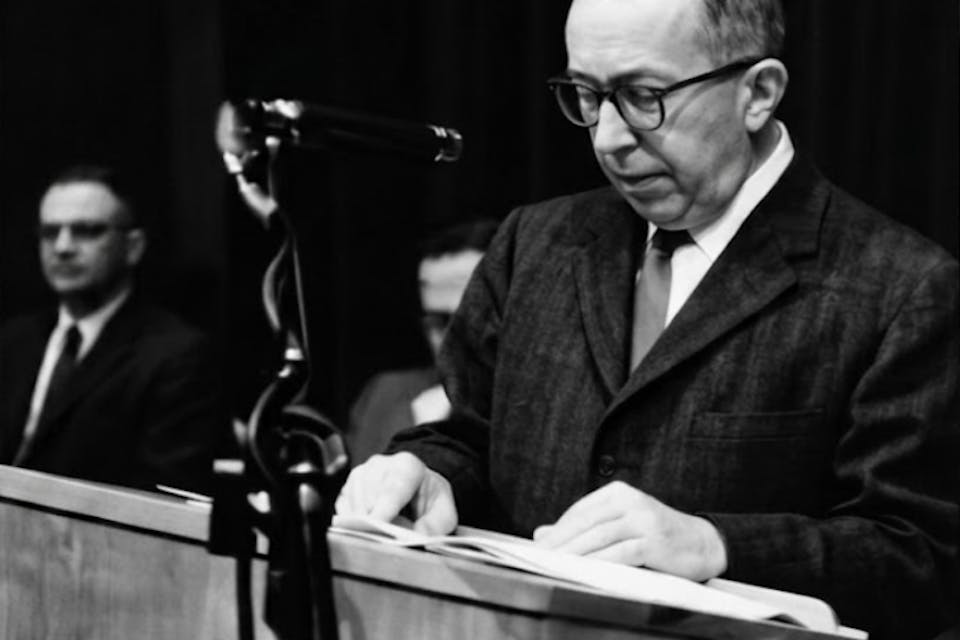
Two-and-a-half years after Hamas’s brutal invasion of Israel, what can Jews look forward to? To many, the answer seems self-evident: more persecution and suffering. More of the past that, as Faulkner said, isn’t even past, let alone dead. With this in mind, a friend recently asked me two questions: why do non-Jews continue to find reasons to hate Jews? And why do we remain Jews if we don’t believe? While I’ve pondered the first question every day since October 7, 2023, I’ve hardly thought about the second—perhaps because, while my observance of the mitzvot is selective, I wouldn’t say that I “don’t believe.” So, prompted by my friend, I dug up an old talk given at the University of Chicago Hillel House by the scholar of political theory Leo Strauss that explains, with great power and clarity, why even Jews who struggle to believe in the God of the Hebrew Scriptures remain Jews today—and what is more, reminds them of what they nevertheless do believe.
Born in Germany in 1899, Strauss was one of the most important political scholars of the 20th century. He studied with the philosophers Ernst Cassirer, Edmund Husserl, and Martin Heidegger, and was deeply engaged with leading Jewish intellectuals in Weimar Germany, including Walter Benjamin, Franz Rosenzweig, Gershom Scholem, and Hannah Arendt. After writing books on Spinoza, Maimonides, and Hobbes, he emigrated to the U.S. in 1937, where he taught at the New School and later the University of Chicago. Teaching and writing on Plato, Machiavelli, Rousseau, and Nietzsche, among others, Strauss used the careful study of great books to introduce generations of students, many of whom would go on to become distinguished academics and public servants, to the constitutive tensions at the heart of the Western tradition: reason versus revelation, philosophy versus poetry, wisdom versus science, ancients versus moderns. This last antithesis in some ways encompasses them all. In seeking antidotes to the scientific reductivism and political extremism of modernity, Strauss looked to the prudence and moderation of older thinkers.
But more than seeking alternatives to modern excesses and disorders in the wisdom of the past, Strauss argued that we had to look to the past to understand ourselves in the first place. In the pages of Commentary in 1967, he wrote that “Western man became what he is, and is what he is, through the coming together of biblical faith and Greek thought. In order to understand ourselves and to illuminate our trackless way into the future, we must understand Jerusalem and Athens.” For Strauss, this creative opposition of faith and philosophy, represented so famously by these two cities, serves as the ultimate source of modernity and our self-knowledge as well as of the civilizationally foundational wisdom that we need to recover.