

June 26, 2026
More Than Muscular Judaism
The study of Tanakh is vital, but it must avoid becoming unmoored from the rabbinic tradition.
As a lifelong student, longtime teacher, and passionate lover of Tanakh, it was deeply satisfying to read Rabbi Ya’akov Trump’s essay outlining the ideological, historical, and sociological factors that caused the decline in the study of the Hebrew Bible among traditional Jews, and its resurgence in modern times. He presents a learned and detailed account of these developments, and of the unfortunate reality that in too many Orthodox circles—especially in the haredi community—the focus on Talmud and other rabbinic texts, to the exclusion of Tanakh, continues to this day. Indeed, in the previous century several rabbinic leaders of the haredi community themselves bemoaned this phenomenon. Rabbi Eliyahu Meir Bloch (1894–1955), one of the heads of the Lithuanian Telz Yeshiva—which survived the Holocaust and reestablished itself in Cleveland—lamented in a celebrated letter that Orthodoxy had abandoned Tanakh to the maskilim (proponents of the Jewish Enlightenment) and the Land of Israel and Hebrew to the Zionists and their religious supporters in the Mizrachi, to the great detriment of the traditional community.
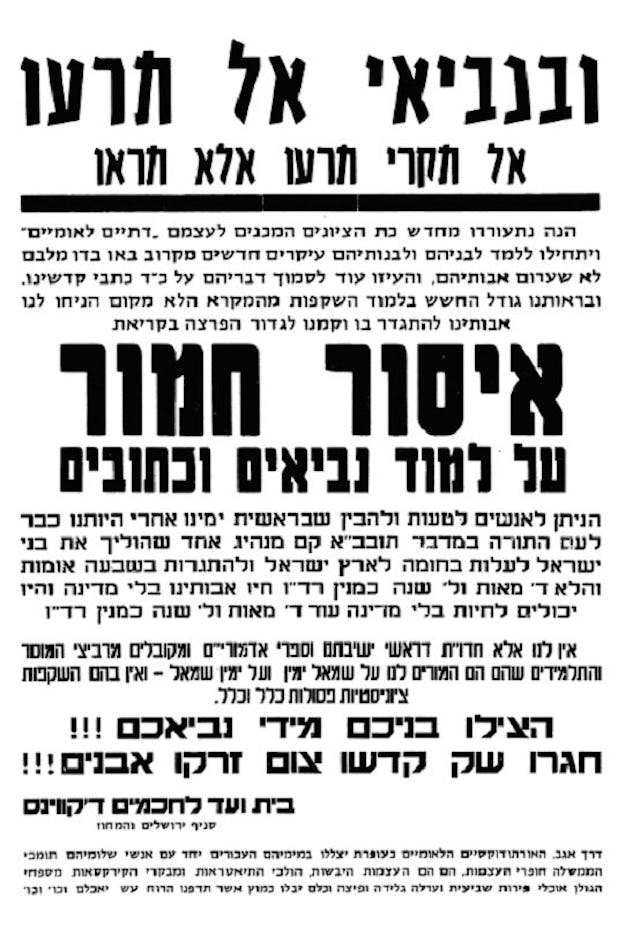
This neglect is so entrenched in the haredi world that it has often given rise to humorous parody. One example that has stayed vividly in my mind dates back to Purim of 1989. Moshe Koppel—now a professor of computer science and the founder of Israel’s Kohelet Policy Forum—was then a young postdoctoral student with a traditional yeshiva education and a great wit. Engaging in the spirit of holiday revelry, he and some friends produced a satirical pashkevil, a broadside that appears on the walls of haredi neighborhoods throughout Israel to announce new edicts, funerals, and communal guidance. The poster, employing the rich rabbinic language, wordplay, and fonts typical of the genre, declared that eminent rabbis had issued a strict prohibition on the study of the biblical Prophets and Writings, since such study might lead people astray: a student, it warned, might mistakenly come to think that our forefathers took up weapons, joined an army, established a state, and captured the Land of Israel from its inhabitants. Copies of the poster (reproduced below) were plastered across haredi neighborhoods in Jerusalem, leaving more than a few innocent passersby uncertain whether this was, in fact, a real proclamation from the elders of the community.