

January 4, 2023
Is the Language Abraham Spoke Engraved on an Ancient Lice Comb?
For the first time, a whole sentence in ancient Canaanite has been found. Only six words long, it brings us many words closer to the age of the Patriarchs.
When, long ago, my two daughters were in elementary school in Israel, they not infrequently came home with itchy heads. “Lice again!” my wife and I would sigh and get to work. The first step was inspection. Although we rarely found living lice, the white specks of their eggs were generally visible. Next came a hair-wash with a special shampoo, an hour spent with the wet hair wrapped in a towel, and a careful combing to rake out the now dead eggs. It all worked pretty well and the itching went away until the next time.
Lice, and even delousing shampoos (the oldest formula for one has been found on an Egyptian papyrus from 1,500 BCE), have been with us immemorially, and special lice combs are among the most ancient surviving artifacts of civilization. Made of wood, bone, or ivory, and sometimes intricately decorated, known examples of them date back to pre-Pharaonic Egypt. Their basic form has not changed much over time. Squarish in shape, they have traditionally had two facing sets of teeth, thicker and fewer at one end of the comb for first unknotting and straightening the hair, and finer and more numerous at the other end for removing the lice and their eggs.
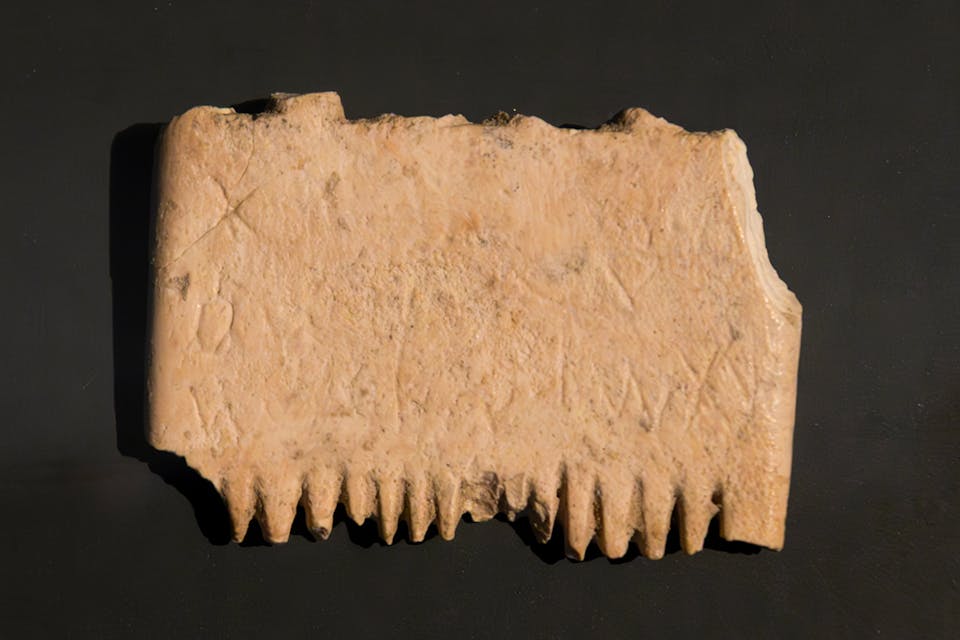
In itself, therefore, there was nothing earthshaking about the discovery in 2016, in an excavation at the site of Lachish in southern Israel, of a little ivory lice comb, 3.66 by 2.51 centimeters, dated by the experts to roughly 1700 BCE—that is, to about the time that the biblical Abraham was wandering up and down Canaan. What made the Lachish comb a news item upon publication last November of an article about it in the Jerusalem Journal of Archeology was that in 2021, five years after its discovery, an investigator examining it with special optical equipment noticed the presence on it of writing. When deciphered by paleographers, this turned out to be an inscription consisting of seventeen letters (two partly illegible that had to be guessed at) in the alphabet of ancient Canaanite, the language that was the precursor of biblical Hebrew just as the Middle English of Chaucer’s time was that of the English we speak today.