
Observation ·
Do Kippot and Keffiyehs Share an Etymology?
By PhilologosOnly one was a mark of prestige for ancient rabbis.


Observation ·
Only one was a mark of prestige for ancient rabbis.
Observation ·
Brought from Arabic via Algerian pirates and Italian merchants, it only acquired its current meaning at the end of the 18th century.
Observation ·
Could "It’s easier to take the Jew out of exile than to take exile out of the Jew" and "You can take the boy out of the country but you can't take the country out of the boy" have shared roots?

Observation ·
A rivalry between the Jewish numerical and European pagan-astronomical nomenclatures for the seven-day week has played out over millennia across the world.

Observation ·
And could the story of the Tower of Babel actually reflect a dim folk-memory of its breakup?

Observation ·
I've been spared an encounter with the neologism until lately. But, frankly, now that I have made its acquaintance, I find it idiotic. (And don't get me started about "goysplaining.")

Observation ·
Only in Schopfloch, as far as I know, have a large number of originally Jewish words survived in the speech of the local populace to this day.

Observation ·
In some cases, changes were minor. In others, Yiddish phrases were transformed nearly beyond recognition.
Observation ·
Quite a few masculine and feminine Hebrew words, when pluralized, take the form of the opposite gender. Why?

Observation ·
Some paleolinguists have floated the idea of an original human language they call “Proto-Sapiens.” Is that what our ancestors were speaking when they built the Tower of Babel?

Observation ·
Israeli politicians have in recent decades become obsessed with calling each other poodels.

Observation ·
Amid the familiar clutter of vowels and cantillation marks, a few strange dots appear. They have no obvious function, and yet they go back thousands of years. Their purpose is . . .

Observation ·
A Mosaic reader was able to solve the mystery of the Yiddish expression tapn a vant, “to grope a wall.”

Observation ·
From Hebrew to Spanish to German to Italian and onward, the term is now as international as Coca-Cola.

Observation ·
It is practically impossible to utter a complete sentence in Hebrew that lacks gender.

Observation ·
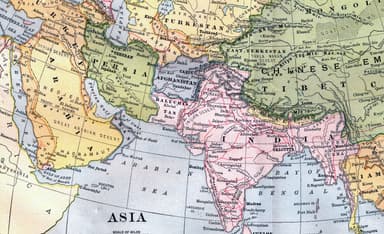
On the possible whereabouts of Ophir and Tarshish, and how to get there by ship from Palestine.
Observation ·
What we learn from the story of the Russian phrase shakher-makher, or wheeler-dealer.
Observation ·
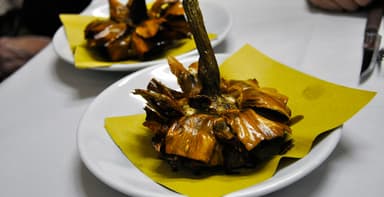
A linguistic investigation prompted by a meal in Rome of carciofi alla giudia.
Observation ·
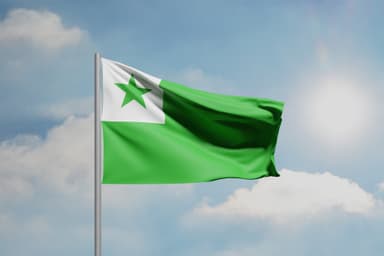
Created by an East European Jew disillusioned with Zionism and Hebrew, the language was meant to unite humanity in a spirit of brotherhood.
Observation ·
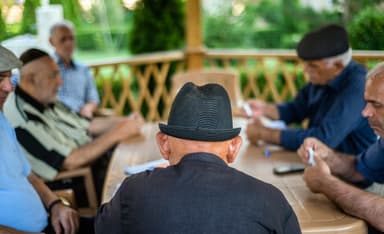
Why certain terms having to do with the basics of life are less prone to linguistic change than others.
Observation ·
What nahagos, the casual term for "driver," tells us.

Observation ·
Why the Hebrew word for "shaming" (as in "Facebook shaming") should not be sheyming.

Observation ·
A centuries-old tale of complicated, ambivalent, and, sometimes, covertly intimate relationships between a largely anti-Semitic Christian society and its Jewish minority.

Observation ·
Is the tech term, as in computer hacker, connected with the verb hakn, meaning to chop?

Unlock the most serious Jewish, Zionist, and American thinking.
Subscribe Now